The Candy Machine Goes Full Arcade (2026 Update)
We’re now in year five of the Halloween candy machine! Every October, I think I’m just going to pull it out of storage, dust it off, and plug it in. And every October, I end up spending weeks adding completely unnecessary features to it.
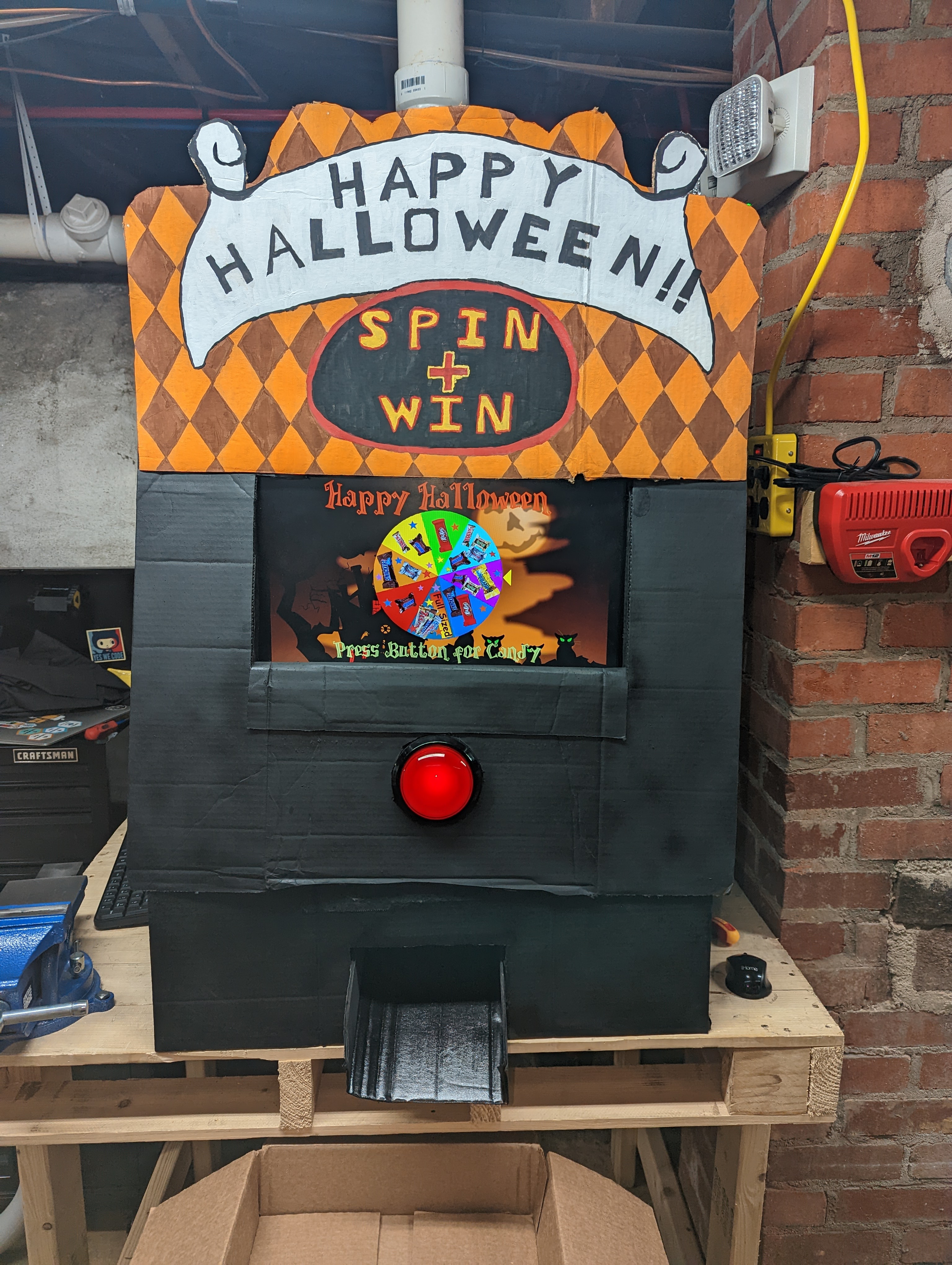
If you haven’t seen the machine before, the short version is: a trick-or-treater walks up, hits a big glowing arcade button, plays a game on screen, and a weight-based hopper/dropper contraption inside dumps that exact amount of candy down a chute into their bucket.
This is the third post in the candy machine series. Check out the older posts to see how it started and how the internals work:
- How I Built My Halloween Candy Machine
 I made a machine for dispensing candy to trick-or-treaters this Halloween (2022)
- What's Inside the Candy Machine
 I made a machine for dispensing candy to trick-or-treaters for Halloween. Here are the updates over the last 3 years. (2025)
In past years, the machine only had one game (a classic spinning wheel), the crowd waiting in the driveway couldn’t see what was happening up at the booth, and I still had to hover nearby in case the candy jammed or ran low. This year, I went all-in on turning the whole porch into an arcade and making the machine smart enough to run itself.
Here are the highlights of what’s new for 2026.
1. Five New Game Modes (Plus Subwoofers!)
For the first four years, every trick-or-treater saw the exact same spinning wheel. Repeat visitors knew the routine by heart, so this year I refactored the display code so I could hot-swap between five different reveal games on the fly—either with a keyboard shortcut or right from my phone.
I also added a subwoofer inside the cabinet with a dedicated low-frequency haptic audio pipeline. Now, when kids rest their hands on the console and hit the button, they physically feel the machine cranking up, the reels clunking into place, and a deep sub-bass rumble when they hit a jackpot.
Candy Corn Spinner
This is the new flagship game for 2026. It’s a 4-slice potion wheel shaped like a giant piece of candy corn, surrounded by chasing marquee bulbs.

Because the prize weight is already weighed out before you press the button, the game knows ahead of time where the needle needs to land—which let me program in some fun fakeouts.
My favorite is the “Broken Motor” gag when someone rolls the smallest prize (xxxs). The needle slowly crawls up toward the top jackpot as the suspense music peaks, freezes at the top for a split second, and then “breaks” with a loud metallic snap. The needle goes limp like an unpowered pendulum, swinging back and forth until it settles at the very bottom on the tiny prize while a crowd-groan sound effect plays:

Even better: if you actually win the top jackpot, there’s a 25% chance of a double-fakeout. It does the exact same broken-motor drop, swings all the way through the bottom, and carries just enough momentum up the other side to snap back into the jackpot slot at the top!
Pumpkin Plinko
Who doesn’t love Plinko? Since the winning bin at the bottom is predetermined by the candy already sitting on the scale, the game solves the physics path backward so the pumpkin bounces off the pegs, plays little acoustic peg-clacks on every hit, and stages a few near-misses before dropping into the right slot.

Haunted Slot Machine
A three-reel gothic slot machine. The first two reels lock in with a heavy mechanical thud, and if you’re rolling for a jackpot (or a tease), the background music ducks out and the third reel spins extra long with a rising suspense tone before slamming into place.

Occult Tarot Cards of Fate
Eight tarot cards laid out on an altar with a glowing pendulum gliding back and forth over them. When you hit the button, the pendulum snaps onto a card with an electric crack, and the card levitates and flips over in 3D to reveal your prize.

The Classic Wheel
And of course, I kept the original 360-degree spinning wheel around for nostalgia—complete with a candy rain celebration at the end.

2. A Second Screen for the Line
As I mentioned in my What’s Inside the Candy Machine I made a machine for dispensing candy to trick-or-treaters for Halloween. Here are the updates over the last 3 years. , our line gets long on Halloween night. The problem is that when you’re standing 20 feet back in the driveway, you can’t see the screen on the machine to know what people are winning.
To fix that, I dug up an old 5th-gen Amazon Fire 7 tablet I had laying around and mounted it facing the line. Because that tablet is ancient, I wrote a lightweight web app in plain old ES5 Javascript and CSS that connects to the main Raspberry Pi over Server-Sent Events (SSE).
While people wait in line, the tablet cycles through:
- Live stats: Total pounds of candy dispensed so far and total trick-or-treaters served.
- How to play: A quick 3-step guide so kids know what to do before they walk up.
- Behind the scenes: A QR code for curious parents that links right to this blog.
The best part is that because it’s hooked up via SSE, the tablet reacts in real time (under 10ms) to what’s happening at the machine. When someone up front hits a jackpot, the line tablet flashes with screen-shaking lightning bolts and announces the win to the whole driveway. Every once in a while, it also throws up a spooky SVG jumpscare just to keep the line on their toes.
3. Fog Machine & Porch Lights
Why stop at the cabinet when you can automate the whole porch?
This year I hooked a ground fog machine (with a chiller so the fog stays low to the ground) and our Govee roof eave lights into the game via Home Assistant.
- Ambient puffs: Every 60 seconds while the machine is idle, the fog machine fires a quick 1.5-second puff to keep a layer of mist rolling across the porch.
- Button anticipation blast: Remember how the machine already knows what you won the moment you press the button? If it sees that you’re about to hit a huge jackpot (or the broken-motor gag), it immediately fires a 3-second blast of fog before the wheel even finishes spinning, covering your feet in mist right as the suspense audio builds.
- Synchronized eave lights: Alongside the NeoPixel strips on the cabinet itself, the house eave lights dim down to an eerie purple during suspense moments, strobe white like lightning on big wins, and cascade rainbow waves while the candy dumps down the chute.
4. Operationalizing with Home Assistant
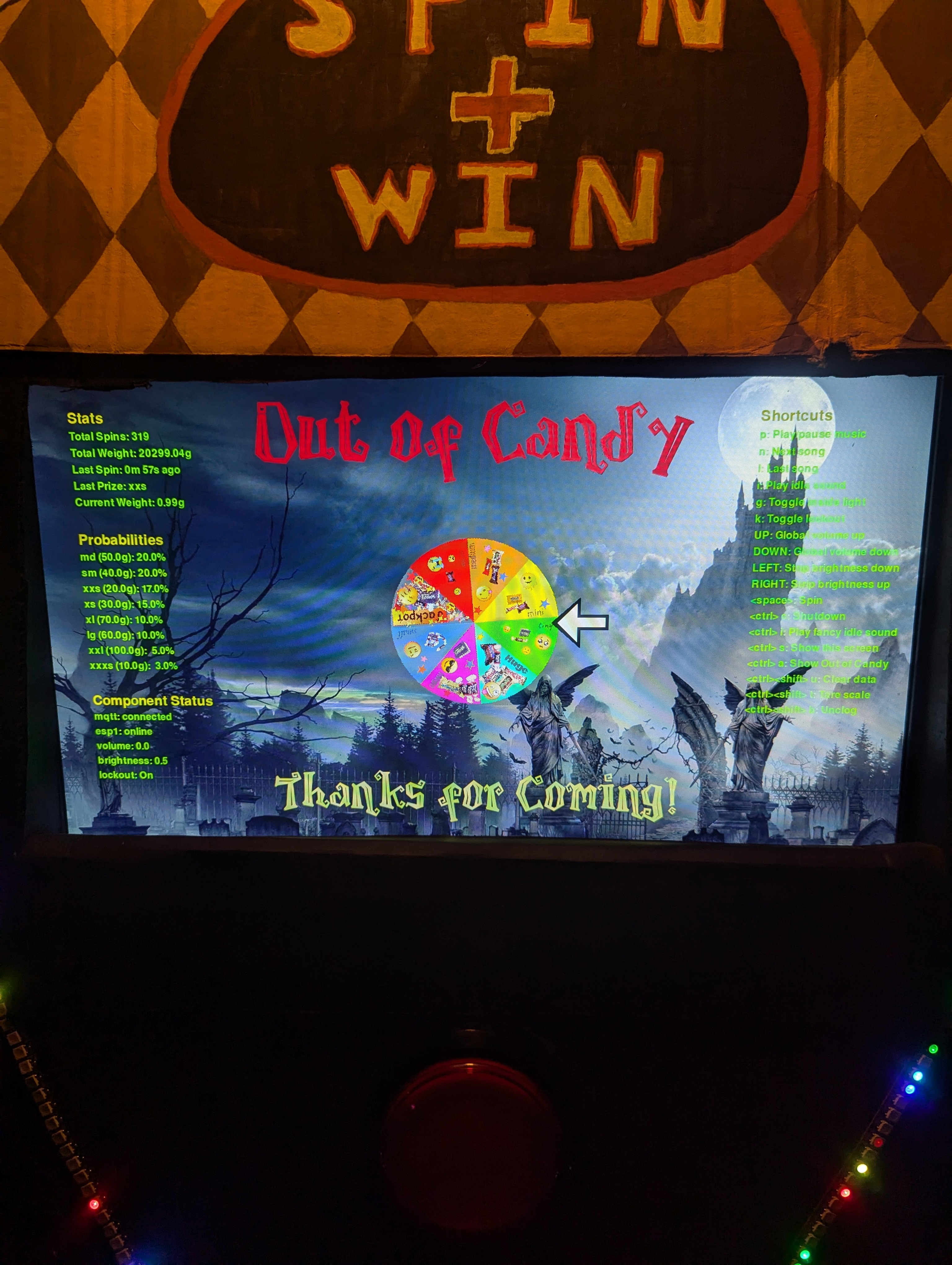
In previous years, I had to babysit the machine pretty closely. If fun-size candy bars formed a bridge inside the bucket, or if the hopper ran completely dry, I wouldn’t know until a kid pressed the button and nothing came out.
This year, I exposed the whole machine to Home Assistant over MQTT (using MQTT auto-discovery) and built a dedicated “Candy Booth” operations dashboard for my phone.
Now, while I’m hanging out in the driveway talking to neighbors, I can pull up Home Assistant to see:
- Candy Remaining: How many pounds are left in the evening budget.
- Projected Runout Time: Based on the current pace of trick-or-treaters, the exact clock time we’re projected to run out of candy.
- Dispense Accuracy & Prep Times: How long the hopper is taking to weigh out each prize and its average error percentage.
- Live Overrides: Buttons to switch the active game mode on the fly, trigger a manual fog blast, tare the scale, run an unclog cycle, or force-dispense candy—all without touching the wireless keyboard.
I also set up push and SMS alerts. If a single hopper prep cycle takes longer than 15 seconds, my phone gets a Hopper Warning notification that candy is starting to bridge so I can give the bucket a quick stir before the next kid walks up. And if it actually runs out of candy, the screen switches to a friendly frowny-face pumpkin (“taking a short restock nap”) and texts me to come refill the bucket.
5. Monte Carlo Simulations & Tuning the Dropper
Two of the biggest headaches with a weight-based candy machine are:
- Making sure you don’t run out of candy at 7:30 PM while kids are still lined up down the block (or end the night with 20 pounds left over).
- Getting an auger in a bucket of irregularly shaped candy bars to quickly and accurately drop just enough candy to hit a target weight without jamming or causing an avalanche.
Instead of guessing at prize odds or testing motor speeds by hand on Halloween afternoon, I built an experimentation suite to do the math for me.
Monte Carlo Prize Budgeting
To dial in the prize distribution, I wrote a script that runs Monte Carlo simulations of Halloween night. Given our total candy inventory and expected foot traffic, it simulates thousands of Halloweens across different probability profiles (default, balanced_9pm, conservative_9pm, and aggressive) and spits out burn-down charts showing when we’ll run out of candy. If it’s a busy year, I can flip to a more conservative profile so every kid still gets a good handful of candy and the bucket lasts right until 9:00 PM.
Dropper Tournament & Precision Metering
On the hardware side, candy isn’t a continuous fluid—a single fun-size chocolate bar weighs around 18–22 grams, and they love to wedge themselves against the hopper wall.
To figure out the best motor programming for the ESP32 controller, I built a calibration harness that runs automated tournaments between different stepper motor pulse profiles across all eight prize tiers, scoring them on speed and accuracy.
Coming out of those experiments, I completely rewrote the hopper firmware:
- High-torque half-stepping & net-negative unclogs: Switching the stepper motor to half-stepping gave it enough torque that jams dropped to 0% across 500+ test cycles. And if candy ever does bridge up, the new unclog routine backs the motor up more than it steps forward, pulling the bridge apart without accidentally pushing an avalanche of candy over the ledge.
- 4-stage proportional metering: When the scale is far from the target weight (>35g away), it uses fast, coarse strokes. As it gets closer, it shifts down through gentle strokes, creep mode, and finally a “nano-creep” trickle mode that nudges the turntable by just 1.7mm at a time to coax a single piece of candy off the ledge.
- No more “phantom drops”: We used to have a weird bug where a piece of candy would sit balanced on the very edge of the ledge after a vend, and vibrations from the next kid walking up would shake it loose into the chute early. Moving the motor’s anti-binding relaxation retreat to the start of the next prep cycle (before taring the scale) solved it completely.
Between the tournament tuning and the new metering zones, our dispensing accuracy (landing within ±5g of the target) jumped from ~72% last year to 96.8% this year.
Bonus: A Full Virtual Cabinet Simulator
One last quality-of-life upgrade for myself: testing code changes used to mean hauling the physical machine out or sitting on the floor next to the Raspberry Pi and ESP32s. This year, I built a --cabinet simulator mode in Pygame that mocks the entire hardware setup on my laptop—complete with virtual NeoPixel strips, 2D candy particle physics falling down the chute, and a simulated load cell bucket.
Resources
As always, all the code, Home Assistant configs, and simulation scripts are open source:
- Code on GitHub
- How I Built My Halloween Candy Machine I made a machine for dispensing candy to trick-or-treaters this Halloween (2022 Original Build)
- What’s Inside the Candy Machine I made a machine for dispensing candy to trick-or-treaters for Halloween. Here are the updates over the last 3 years. (2025 Internal Redesign)